
Electronics Restoration After Fire, Smoke & Water
Can Smoke-Damaged Electronics Be Restored? A Denver Owner's Guide
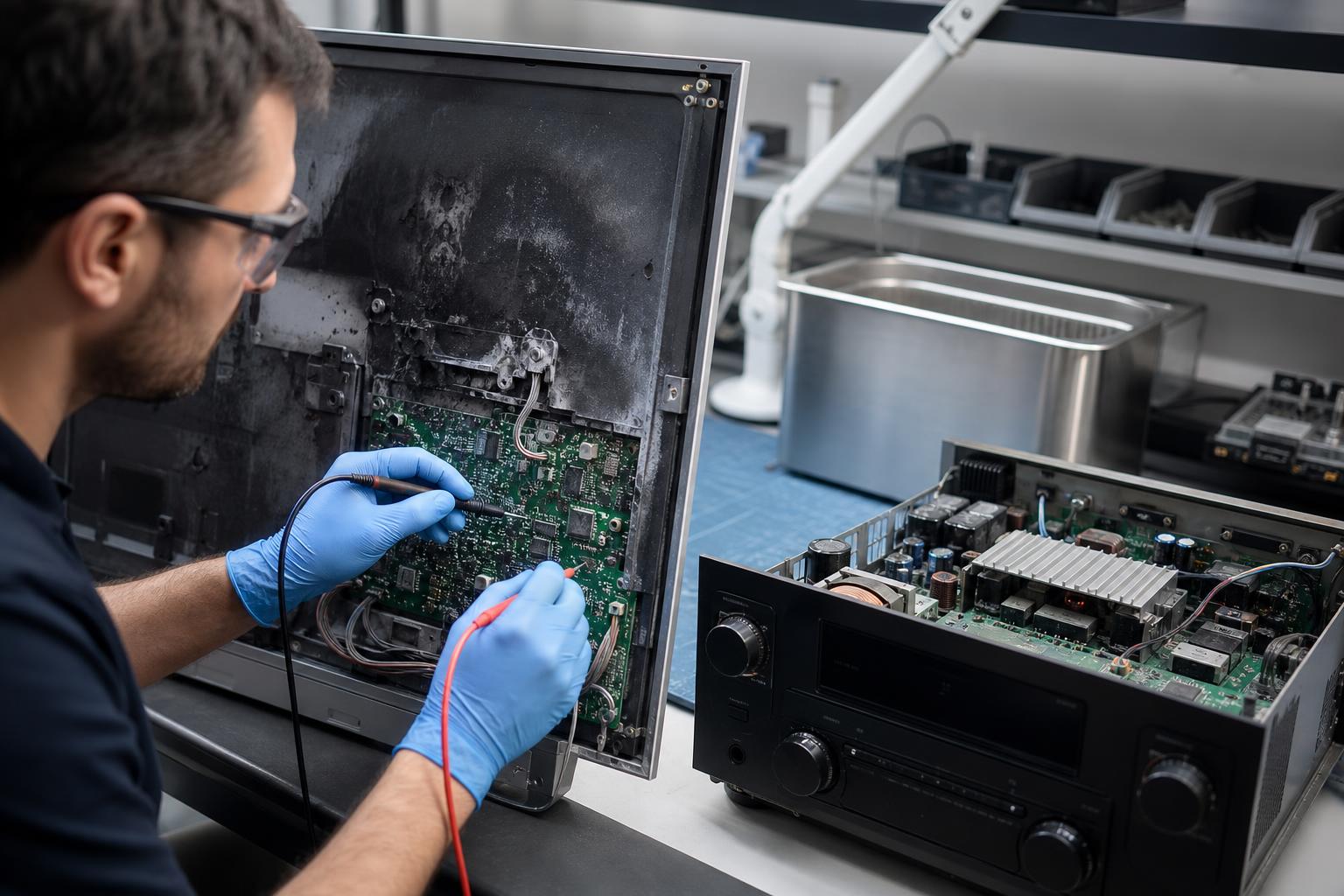
After a house fire, the television usually looks fine from the front. The plastic bezel is intact. The screen is not cracked. But the answer to "can I just plug it back in?" is a firm no. Smoke residue is acidic, conductive, and hygroscopic, which means it attracts moisture out of Denver's dry air and slowly eats circuit boards from the inside. Turning on a smoke-damaged electronic before it has been professionally cleaned is the single fastest way to destroy it. Here is what actually happens in a restoration lab, what your insurance pays for, and how to tell whether a device is worth restoring or replacing.
Why smoke damage is so dangerous to electronics
House-fire smoke carries chlorides from burned plastics and vinyl. Chlorides are among the most corrosive residues in existence. On a circuit board they form a thin conductive film that bridges pins, shorts traces, and corrodes solder joints. Left alone, this residue keeps eating the electronics for months. Powering on the device accelerates the corrosion and often causes it to fail catastrophically within days or weeks of the fire, long after your claim is closed.
What a restoration lab actually does to a smoke-damaged TV
A professional electronics technician opens the device, documents its pre-cleaning condition, removes the boards, and cleans each one with a combination of specialized electronics-safe solvents and ultrasonic baths. Connectors are polished. Fans and heat sinks are decontaminated. Anything that cannot be cleaned safely is replaced. Then, the crucial step most consumer repair shops skip: the device is reassembled and tested at every input and output. HDMI 1, HDMI 2, HDMI 3, USB, optical audio, tuner, network, remote sensor. Every one. A device that only "turns on" is not restored.
What insurance covers, and how adjusters think about it
Contents coverage on a standard homeowner policy pays to either restore or replace personal-property electronics damaged by a covered peril. Adjusters generally follow a simple rule: if professional restoration costs less than a comparable replacement and the device passes post-restoration testing, restoration is preferred. This is almost always the case for larger and higher-value items like flat-screen TVs, receivers, gaming consoles, computers, and appliances. For lower-cost items like a $60 clock radio, replacement is usually the answer.
Items worth restoring almost every time
- Flat-panel and OLED televisions 55 inches and larger
- AV receivers, amplifiers, and separate DAC or preamp units
- Turntables, especially with original cartridges
- Desktop computers, gaming PCs, and workstations
- Vintage or high-end audio equipment
- Major kitchen appliances built into cabinetry
- Anything with sentimental value that is not obviously destroyed
Items usually not worth restoring
- Cheap consumer electronics under a few hundred dollars unless they cannot be replaced
- Devices with visible thermal damage or melted housing
- Batteries and battery-operated small devices
What to do before the restoration team arrives
Do not plug anything in. Do not wipe surfaces with a household cleaner: that pushes residue into the device. Do not throw anything away without documenting it. If a device is visibly wet, keep it out of a sealed bag or box because trapped moisture accelerates corrosion. Then let the restoration team inventory, pack out, and transport everything to a controlled facility.
The Denver difference
Because our climate is so dry, homeowners often assume smoke residue "aired out" on its own. It does not. The visible smell fades because volatile compounds evaporate, but the corrosive residue stays. Every device from a smoke event needs professional cleaning, even if it looks and smells fine a week later.